
Concrete Slab Formwork: Plywood, Plastic and Light Steel Formwork
The three types of concrete slab formwork have distinct applicable scenarios in construction engineering. Plywood formwork features low cost and high flexibility, making it ideal for small-scale, non-standard and one-time construction projects.
6/22/20264 min read
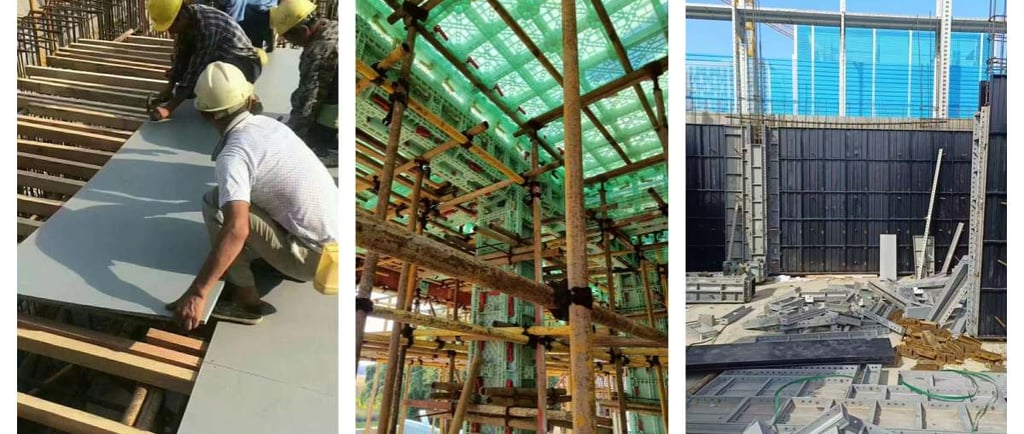
Comparison of Three Common Concrete Slab Formwork: Plastic Plywood, Plastic and Light Steel Formwork
Concrete slab formwork is a temporary structural component used to support fresh concrete during pouring and curing processes. It governs the surface finish, flatness and dimensional accuracy of concrete slabs, while significantly affecting construction efficiency, project cost and on-site construction safety. In modern building engineering, wood-based plywood, plastic, and light steel formwork are the three most prevalent types of slab formwork. Each material has unique structural characteristics, economic advantages and inherent limitations. This paper elaborates on the pros and cons of the three formwork systems to provide practical guidance for engineering selection.
1. Plastic Plywood Formwork
Plastic plywood formwork is a traditional and widely adopted construction formwork. It is manufactured by bonding multiple layers of wood veneers with waterproof adhesive, with standard thicknesses ranging from 12mm to 18mm. Supported by wooden joists and steel brackets, it is extensively used in small and medium-sized slab construction due to its mature production technology and convenient on-site operation.
1.1 Advantages
Plywood formwork features low initial cost and outstanding construction flexibility. Its affordable material price and low auxiliary equipment requirements make it highly suitable for budget-restricted and small-scale projects. Light in weight and easy to cut and splice on site, it can adapt to irregular slabs and special-shaped structural nodes, solving the forming difficulties of non-standard building structures. Furthermore, its smooth surface effectively reduces surface defects on concrete, minimizing subsequent plastering and repair work. The simple assembly process lowers construction thresholds, as ordinary workers can operate proficiently without professional training.
1.2 Disadvantages
The most prominent drawback is its low reusability. It can only be recycled 3 to 5 times, and repeated use easily causes delamination, cracking and edge damage, resulting in high long-term replacement costs for large-scale projects. As a hygroscopic wood-based material, plywood tends to absorb moisture in humid or rainy conditions, leading to swelling, warping and slab surface deformation. It possesses low structural rigidity, which may cause concrete bulging and uneven slab thickness under concrete pressure. In addition, it is flammable, vulnerable to cement chemical corrosion, and generates considerable construction waste after disposal, resulting in poor durability and environmental performance.
2. Plastic Formwork
Plastic formwork is an innovative environmentally friendly construction material, primarily produced by integral molding of modified PP and ABS engineering plastics. As a modular assembled formwork system, it is widely applied in standardized slab construction for residential buildings, industrial plants and municipal projects, and has gradually replaced traditional plywood in medium-to-large repetitive construction projects.
2.1 Advantages
Plastic formwork delivers excellent durability and a high reuse rate of 20 to 50 times, which substantially reduces the overall material cost of repetitive construction projects. It is waterproof, alkali-resistant and corrosion-resistant, maintaining stable structural performance in humid and harsh construction environments without water absorption or deformation. Its integrated smooth surface produces high-quality concrete finishes, eliminating the need for secondary plastering and saving labor and material expenses. The lightweight modular structure allows for convenient assembly and disassembly without on-site cutting, greatly accelerating construction progress. Moreover, waste plastic formwork is fully recyclable, generating minimal construction waste and providing superior environmental benefits.
2.2 Disadvantages
The main limitation is its high initial procurement cost, making it economically unviable for small-scale, one-time and non-standard projects. Composed of fixed-size standard modules, plastic formwork cannot be flexibly adjusted or cut on site, leading to poor adaptability to special-shaped and variable-size slab structures. It also has unstable temperature resistance: it softens and deforms under extreme high temperatures and becomes brittle and prone to cracking in low-temperature environments. Additionally, its structural rigidity is lower than that of steel formwork, restricting its application in super-thick concrete slabs with high pouring pressure.
3. Light Steel Formwork
Light steel formwork is a high-precision assembled system fabricated from thin-walled light steel profiles through cold bending, welding and professional anti-rust treatment. Equipped with standardized panels and matching supporting accessories, it serves as an efficient and high-performance formwork solution for high-rise buildings, large commercial complexes and large-batch standardized construction projects.
3.1 Advantages
Light steel formwork boasts ultra-high structural rigidity and forming accuracy. It can withstand high concrete pouring pressure, effectively preventing slab deformation, bulging and displacement to guarantee high-precision construction quality. With a reuse rate of over 100 times and negligible material loss, it presents remarkable economic advantages for large-scale batch construction. Treated with professional anti-rust and anti-corrosion processes, it adapts to various harsh construction environments and achieves a long service life. Its standardized modular assembly significantly improves construction speed and overall efficiency. In terms of safety and environmental protection, it is non-flammable with a high on-site safety factor, and all steel components are fully recyclable, realizing zero construction waste.
3.2 Disadvantages
Light steel formwork requires a huge upfront investment due to its high processing and supporting system costs, which is impractical for small-scale and temporary construction projects. It is considerably heavier than plywood and plastic formwork, requiring mechanical hoisting and skilled professional operators, which increases on-site equipment and labor costs. Its fixed-size modules lack construction flexibility and cannot adapt to special-shaped structures and personalized building designs. Furthermore, long-term service may cause steel rust, component deformation and accessory wear, necessitating regular maintenance and part replacement and increasing subsequent operational costs.
4. Conclusion
The three types of concrete slab formwork have distinct applicable scenarios in construction engineering. Plywood formwork features low cost and high flexibility, making it ideal for small-scale, non-standard and one-time construction projects. Plastic formwork achieves a balance of economic efficiency and environmental protection, suitable for medium-sized standardized repetitive construction. With high precision, high efficiency and excellent reusability, light steel formwork is the optimal choice for large-scale batch construction and high-standard high-rise projects. In practical engineering, construction teams shall select formwork systems comprehensively based on project scale, structural complexity, budget and construction cycle to maximize construction quality and comprehensive economic benefits.
Solutions
Comprehensive concrete formwork and reinforcement systems.
Contact
Email: kevin@zhuniuformwork.com
Whatsapp/Wechat: +86 180-5453-3152
© 2025. All rights reserved.Company:Linyi Zhuniu Building Materials Co., Ltd